Month: January 2026

Leader of the week - Kurt Hanevik

Publishing at K2
When the UiB Rector visited K2 last week, she asked about our publication strategy. K2’s strategy is quite simple: We publish open access as much as possible, and when we have strong and very interesting data, we try to publish in so called Level 2 journals. These are the top 20% highest-ranked journals within their field, and the list is updated annually by the National Publication Committee (NPU) and HK-dir. In 2024, 18% of K2’s 422 publications were in Level 2 journals. This is also the average for the Faculty of Medicine. For K2, it should be an objective to exceed 20% in Level 2 publications in order to demonstrate the overall quality of our research. Unfortunately, many Level 2 journals are still not fully open access. We can help promote fully open access Level 2 journals by publishing in them and having publication fees covered by UiB’s

Based on the number of publications, levels, and international collaboration, publication points are calculated. Until 2024, these were used to adjust funding for research institutions in Norway. This is no longer done, but the metric may still be a useful indicator to monitor, considering how well we manage under increasingly tight budget constraints. In the health trusts, publication points will continue to influence funding.

For this statistic to be accurate, it is important that affiliations are written correctly in submitted manuscripts from K2. AI tools often mistranslate this. The correct affiliation, where K2 is the employer or has otherwise contributed to participation in a study, is:

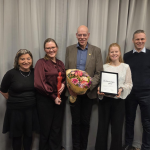
Finally, the K2 leadership congratulates Lars Herfindal, Professor of Pharmacology and the new Head of the Centre for Pharmacy, on receiving the prestigious Olav Thon Foundation Award for Outstanding Teaching.

Friday waffle with Wafflepitch at Eitri

Friday waffle with Wafflepitch at Eitri: Calum Leitch and Irini Ktoridou-Valen: "Repurposing Medicines for Blood Cancer: ValQ and the Bjørgvin Therapeutics Group."

Friday, January 30, 2026

13:00  14:00

Location: Eitri, Haukelandsbakken 31, 5021 Bergen

Despiccable - Misuse of the publication fund

We are fortunate to have a publication fund at UiB that covers article processing charges for fully open access journals. Unfortunately, some individuals have exploited this to mass produce weak articles published in open access journals with poor peer review.

Read the rest of the story by clicking "read more"

ERC Starting Grant Development Programme 2026

In 2024, UiB launched an ERC Starting Grant Development Programme. This programme will continue in 2026, and a new round is being initiated for researchers planning to apply for the ERC Starting Grant call in autumn 2026. The programme supports ERC Starting Grant applicants through three phases: concept development, project development, and proposal writing. Two seminars are planned (March and April), as well as a writing seminar in June. K2 will send a list of interested candidates to the faculty by 18 February. Those interested are asked to contact kurt.hanevik@uib.no.

Furniture is being given away – first come, first served.

In connection with the reorganization of the research fellow spaces on the 8th floor of the Laboratory Building, we currently have a large number of chairs, desks and drawer units left over.

The furniture is being given away, and employees in need are welcome to help themselves.

To arrange a pick-up or for more information, please contact:

Ingri Lunde – Ingri.lunde@uib.no

Irene Hjelmaas – Irene.hjelmaas@uib.no

The furniture is distributed on a first-come, first-served basis.

UiB at Arctic Frontiers 2026

The University of Bergen is once again present at Arctic Frontiers in Tromsø – an international meeting place that brings together researchers, business, politicians and representatives from local and indigenous populations to discuss developments in the Arctic region. This year's conference includes a foreign policy summit with the foreign ministers of Norway, the EU and Greenland, in addition to a number of scientific sessions and side events.

UiB is one of two universities that is a senior partner in Arctic Frontiers, and will participate in 2026 with several academic presentations, panel discussions and events that demonstrate the breadth of the university's Arctic-related research.

Ole F. Norheim honored by Gates Foundation

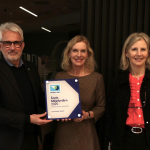
Ole F. Norheim received the award at the Gates Foundation Goalkeepers Nordic event in Stockholm on January 22. The award is being presented for the first time and highlights Nordic leaders who contribute to progress towards the UN's 17 Sustainable Development Goals.

UiB will educate Europe's new experts in digital endocrinology

UiB now leads the European network Endotrain, which will educate 19 PhD candidates in digital endocrinology. The research leaders met in Bergen in January to plan the projects and the doctoral education. The network will further develop continuous hormone measurements and combine them with digital data on sleep, stress and activity to provide earlier diagnosis and more precise treatment of hormonal diseases. The candidates will receive an interdisciplinary education with contributions from clinicians, mathematicians, lawyers, ethicists and industry partners. The project gives UiB an important opportunity to build new expertise and strengthen both European and internal professional collaboration.

Leader of the week - Silke Appel

Dear everyone,
This was an extraordinary week: On Monday I received the joyful news that Lars Herfindal, head of the Center for Pharmacy, has won the Olav Thon Foundation Prize for Outstanding Teaching in Higher Education (Read more for links) Then it was announced on Wednesday that K2 will get a new KG Jebsen Center for Medical Research (Epimutations in Cancer), led by Stian Knappskog ((Read more for links) I am incredibly proud and congratulate you! The awards came just in time before the visit of the university management on Thursday where I took the opportunity to brag about both outstanding teachers and researchers at K2.

And when it comes to awards: The faculty has, as every year, announced the faculty's awards. For the research awards, K2 can nominate one candidate per category (except PhD work, in which case we can nominate 2 candidates). For the teaching award, the candidates must be nominated by an environment (e.g. departments, programme committees, subject groups, semester boards, research groups, networks and student organisations/cohorts. An environment can also nominate itself.)

The nominations must include a description of the initiatives in question, refer to the results achieved and discuss the transfer value and further plans for the initiatives.
The following may be grounds for nomination:
Quality-enhancing initiatives in education, including practical training
Initiatives to promote good learning environments
Work to facilitate increased internationalisation
Testing of new forms of teaching and assessment, including digital innovations
Extended use of student-active learning

Reasoning Publication of the Year
The departments are asked to provide a justification that includes arguments for quality, originality and innovation. Where relevant, the institute should also account for the consequences for further knowledge acquisition, clinical application or innovation. Nominations for publication of the year should reflect the department's own research.

Reasoning for this year's PhD work
The departments are asked to provide a brief justification that includes arguments for quality, originality and innovation. Where relevant, the institute should also account for possible consequences for further knowledge acquisition, clinical application or innovation. In addition, the candidate's own contribution and independence must be described.

Reasoning Research Environment of the Year
The institutes are asked to provide a justification that includes arguments based on research production, scientific quality or ability to innovate. The working environment, recruitment, gender balance and the ability to develop young researchers will also be emphasised and must be presented in the justification. The environment that is nominated should have close cooperation and not have the character of being a loosely linked network. In addition, contributions to national and international research collaboration, networking and contributions to the education of students and PhD candidates should be commented on.

Reasoning for the Dissemination Award
The institutes are asked to provide a brief justification that includes arguments for how a researcher or a research group has been able to communicate recent research in an outstanding way to a broad audience. Research dissemination shall be of high quality with regard to academic content, design and execution. It should engage, arouse curiosity, provide inspiration and new knowledge. The dissemination shall respond to society's need for information and knowledge about research and higher education.

Reasoning for the Innovation Award
The OECD defines innovation as the implementation of a new or significantly improved product (good or service), or process, a new marketing method, or a new organizational method in business practice, workplace organization, or external relations. Innovation also includes innovation activities in education.

The Innovation Award at the Faculty of Medicine is awarded to a person, a group or an innovation environment that meets one or more of the following criteria:
1) Has worked proactively, creatively and research-based to produce health-promoting solutions to solve current societal challenges. This includes, but is not limited to, products, services, educational tools, etc.
2) Has worked to promote innovation culture and talent development within the field of innovation at MED.
3) Has worked to promote innovation activities in the field of education at MED.

Therefore, I ask to nominate candidates via the following links by February 2:
• (Read more for links)

Have a really good weekend!
Silke

Technician's Day 2026 – well done!

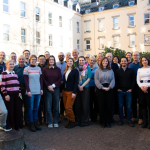
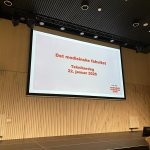
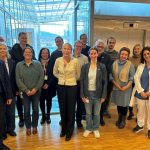
On Thursday, January 22, the technicians at the Faculty of Medicine gathered in the Great Hall for a rich and inspiring Technicians' Day 2026. The day offered a varied program with professional presentations, reflection, good conversations and useful perspectives on both working life, competence and future challenges.

UiB is the environmental lighthouse of the year for 2025

The University of Bergen has been awarded the Environmental Lighthouse of the Year 2025 award in the group and large enterprises category. The jury's justification highlights that UiB "has demonstrated targeted and comprehensive environmental management over time", and that the university's climate and environmental work is firmly anchored in top management and produces documentable results.

Funds for collaborative projects within Global Societal Challenges 2026

Global Societal Challenges (GSU) is one of three priority areas at the University of Bergen. Funding is allocated to various activities such as events, visiting scholar stays, seminars, and other initiatives that can help develop cross faculty research projects related to the theme of “inequality” in a broad sense. Applications should include concrete plans for continued research collaboration and the submission of proposals to external funding sources. Application deadline: 1 March 2026.

UiB project receives over five million euros to reduce child mortality

UiB has received 5.3 million euros from the EU for the PRoRota project, which will investigate whether probiotics, better hygiene education and mathematical models can reduce child mortality related to diarrhea in low- and middle-income countries. The project tests whether probiotics can improve the effect of the rotavirus vaccine in a large study with 4,000 newborns in Tanzania, Malawi and Ivory Coast. In addition, a warning system for rotavirus outbreaks is being developed and research is being conducted on how WASH routines can work better in practice.